Core Foundations of Google Ads & PPC
Pay-Per-Click is an internet marketing model where advertisers pay a fee each time one of their ads is clicked. Instead of earning organic traffic, you are essentially buying visits to your website.
Google Ads operates on an auction-based system. Whenever a user performs a search, an auction takes place based on advertiser bids and Quality Score to determine which ads appear and in what order on the Search Engine Results Page (SERP).
Google evaluates your ad relevance, expected click-through rate (CTR), and landing page experience. A higher Quality Score lowers your cost-per-click (CPC) and secures better ad placement positions.
Campaign Types & Ecosystem
These are text-based ads that appear on Google SERPs when users search for specific products or services. They are ideal for capturing high-intent, bottom-of-the-funnel buyers.
These are visual banner or image ads shown across millions of partner websites, apps, and Google-owned properties (like Gmail). They are primarily used for brand awareness and remarketing.
Specifically designed for e-commerce, Shopping ads display product images, prices, and merchant names directly on Google. Performance Max utilizes Google’s machine learning to run dynamic ads across all channels from a single automated campaign..

Ad Creation & Account Structure
A well-structured account is broken down into Campaigns (aligned with broad goals or budgets) and Ad Groups (thematic groupings of tightly related keywords and matching ads).
High-performing ads lead with clear user benefits, incorporate strong value propositions, and feature powerful calls-to-action (CTAs).
Ad Assets (Extensions): Formerly known as extensions, assets add extra information like phone numbers, site links, location details, and callouts to make your ad larger and more clickable.
Bidding, Budgeting, & Optimization
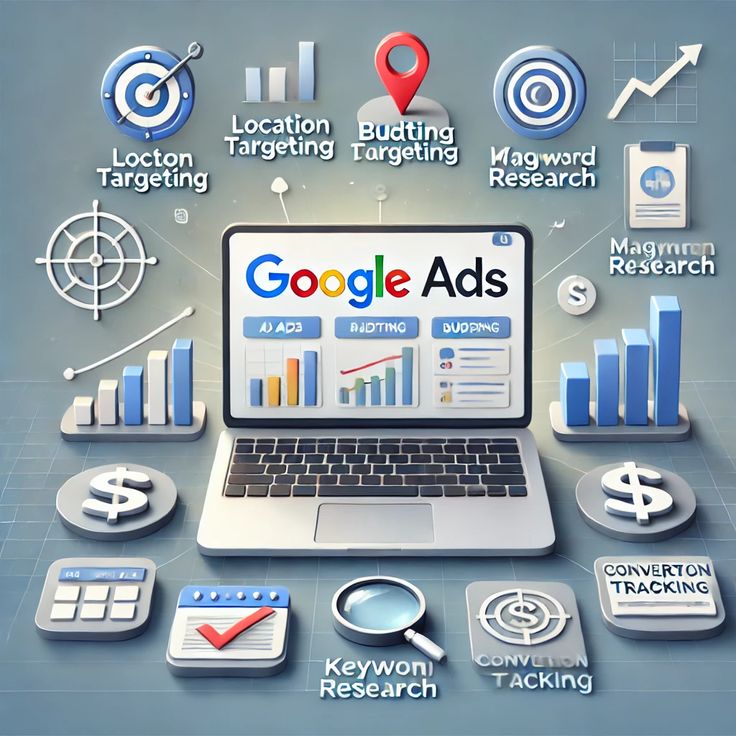
You can choose manual bidding for granular control or automated smart bidding strategies like Maximize Clicks, Target CPA (Cost-Per-Acquisition), or Target ROAS (Return on Ad Spend) which lean on Google’s AI to optimize conversions.
Your ad is only as good as the page it links to. A high-converting landing page must feature seamless “message match” with your ad text, fast load speeds, and a clear conversion path.
Setting up conversion tracking (for form fills, purchases, or phone calls) is non-negotiable. Tracking metrics like CTR, Conversion Rate (CVR), and Cost Per Lead (CPL) ensures you can calculate your true return on investment.